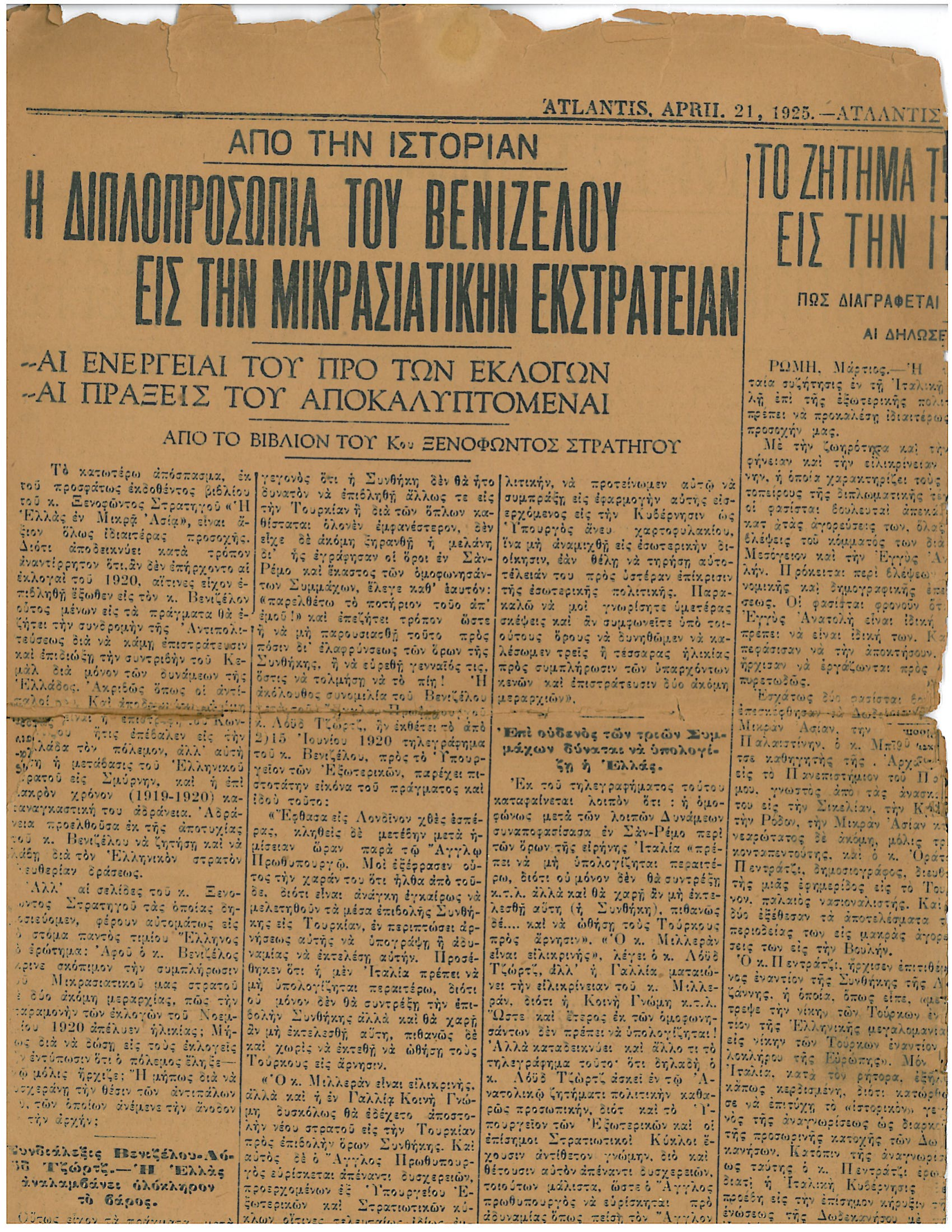
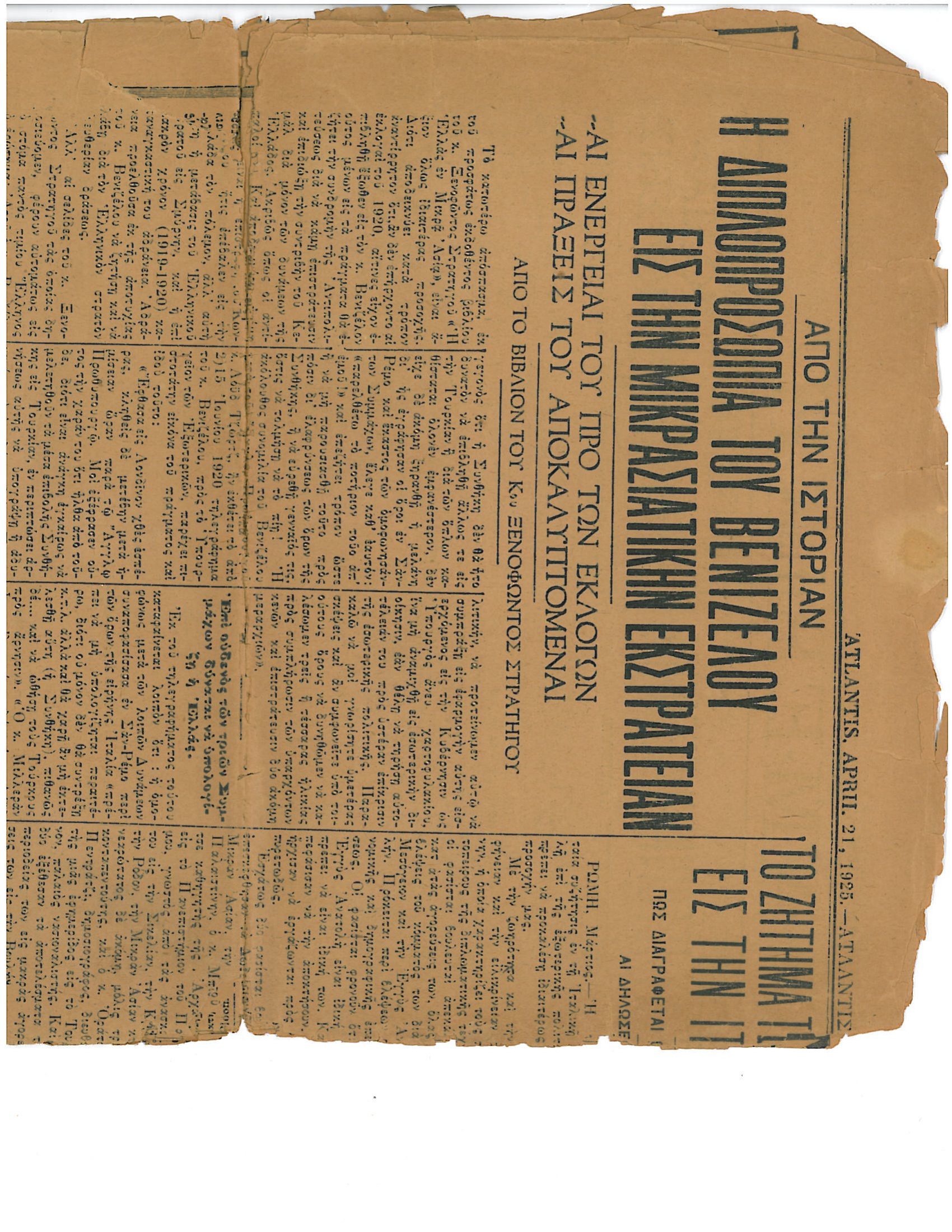
A two-page newspaper clipping from ATLANTIS — the major Greek-American daily newspaper published in New York City from 1894 to 1973 — dated April 21, 1925. The front-page headline reads:
“Η ΔΙΠΛΟΠΡΟΣΩΠΙΑ ΤΟΥ ΒΕΝΙΖΕΛΟΥ ΕΙΣ ΤΗΝ ΜΙΚΡΑΣΙΑΤΙΚΗΝ ΕΚΣΤΡΑΤΕΙΑΝ”
(The Double-Dealing of Venizelos in the Asia Minor Campaign)
Subheads: “His actions before the elections” and “His deeds revealed.” The article is a serialized excerpt from a book by Xenophon Stratigos — a contemporary critique of Eleftherios Venizelos’s role in the disastrous Greek occupation of Smyrna (1919) and the 1919–22 Asia Minor campaign that ended in the 1922 catastrophe. Topics covered in the text body include the secret Venizelos–Lloyd George correspondence, the San Remo conference (April 1920), and the consequences of the Greek occupation for the Anatolian Greek population.
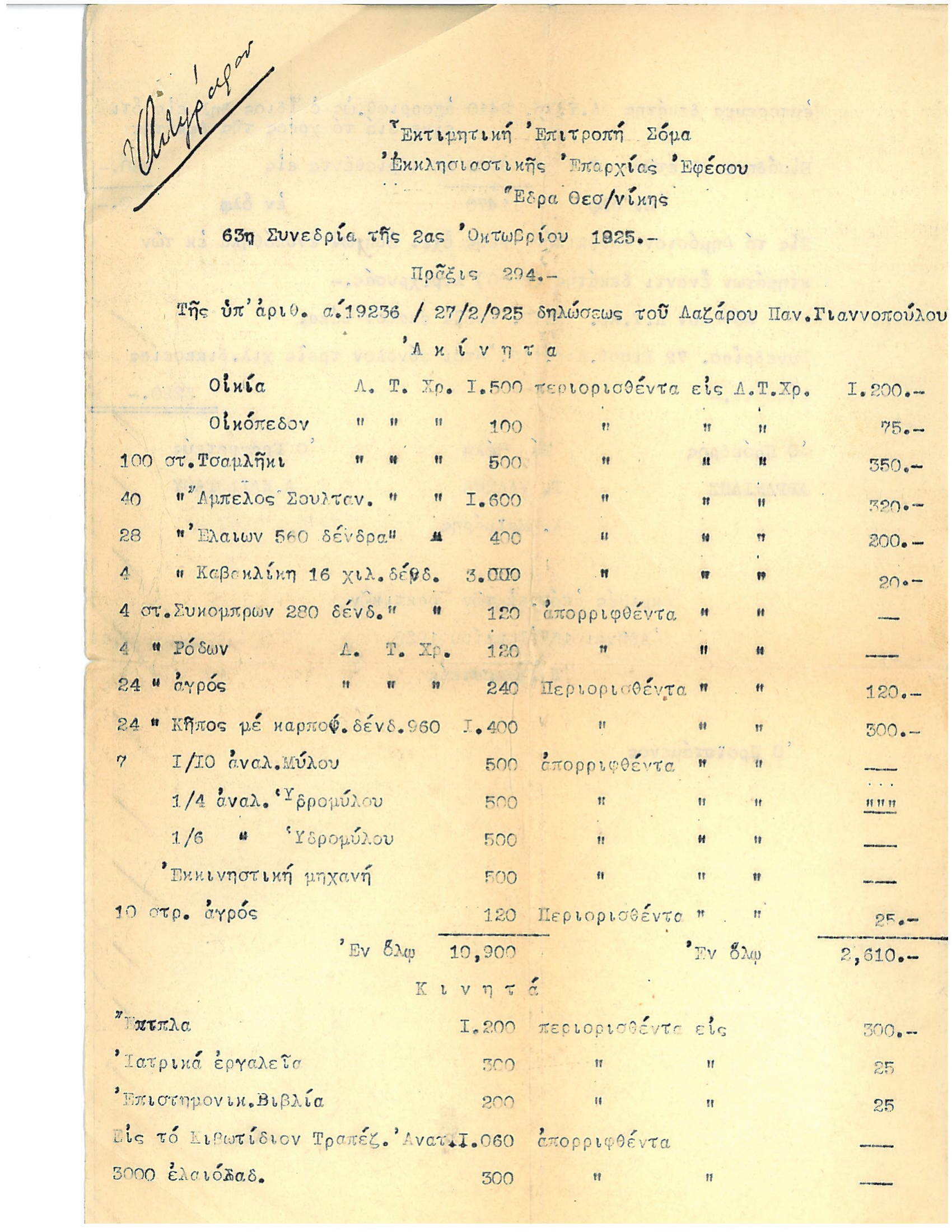
That this article was clipped and saved in Lazaros’s personal archive is a piece of political evidence. Lazaros was a Greek dispossessed in the 1922 catastrophe — losing a Soma estate he himself declared at approximately 14,000 Turkish gold pounds (roughly $10 million in today’s gold-equivalent wealth; the Greek state would later approve only about 23 percent of the claim) and forced to flee with his family first to Lesvos and then to New York. The conservative Greek-American press attributed the catastrophe to Venizelos’s overreach in 1919–20. By keeping this critique on file in 1925, Lazaros aligned himself with the anti-Venizelist axis of Greek-American politics.
Combined with the other political documents in his archive — the handwritten open letter to General Theodoros Pangalos (the dictator who overthrew the Venizelist Republic in June 1925), dated to the 1925–26 Pangalos regime; his 1933 anti-Athenagoras Bronx parish activism (Athenagoras was the establishment-aligned Archbishop of North and South America); and his editorial role at the dissident-faction newspaper Aletheia from at least 1932–1935 — Lazaros’s politics form a coherent royalist, conservative, anti-Venizelist position spanning the full decade of Greek-American political life in which he was active.
The war the article was about
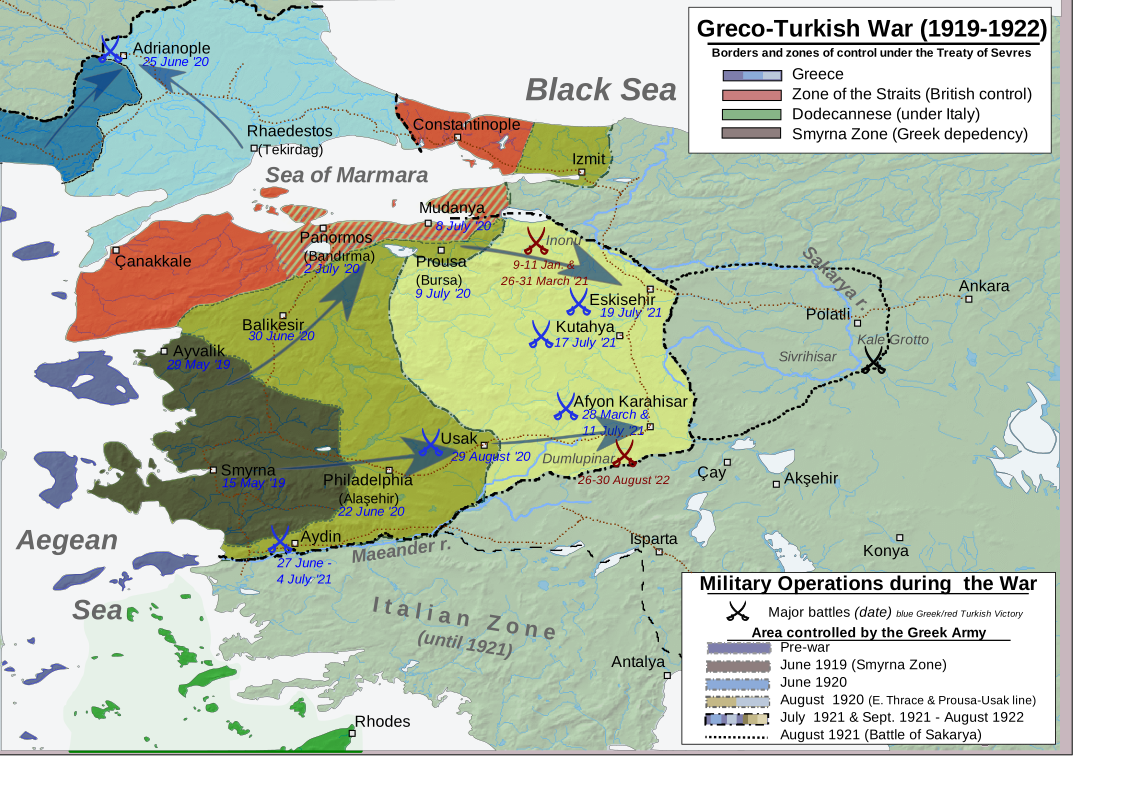
The Greco-Turkish War, 1919–1922 — the campaign Stratigos’s serialized book in Atlantis attacked. The Greek army landed at Smyrna in May 1919 and pushed east into the Anatolian interior; by September 1922 the front had collapsed and the Greek forces were driven back into the sea at Smyrna, leaving the Anatolian Greek civilian population behind them to be massacred or expelled. Soma sits inside the western Anatolian theater shown here, about 80 km north of Smyrna — among the towns the catastrophe emptied.