Ines was a name she chose for herself. Her birth name was Agnes Cicchinelli, registered in St Albans La Roche, France, on January 23, 1925, to Sicilian-heritage parents — a father, Achilles Cicchinelli, who would walk out on her after her mother’s early death, and a mother, Amelda Menouti, whose name may also be Sicilian. She kept Agnes for official paperwork her whole life and used Ines Valda everywhere else; her American personal checks were signed “Ines V Jeannopoulos aka Agnes.”
Her childhood was shaped by loss. Amelda died in her thirties of a heart ailment, presumably linked to earlier rheumatic fever; her father left the household soon after. Aline, decades later: “She was very secretive about her past…I believe her father left at that point. My impression was that she hated him.”
World War II — Resistance, Wiener Neustadt, Soviet liberation
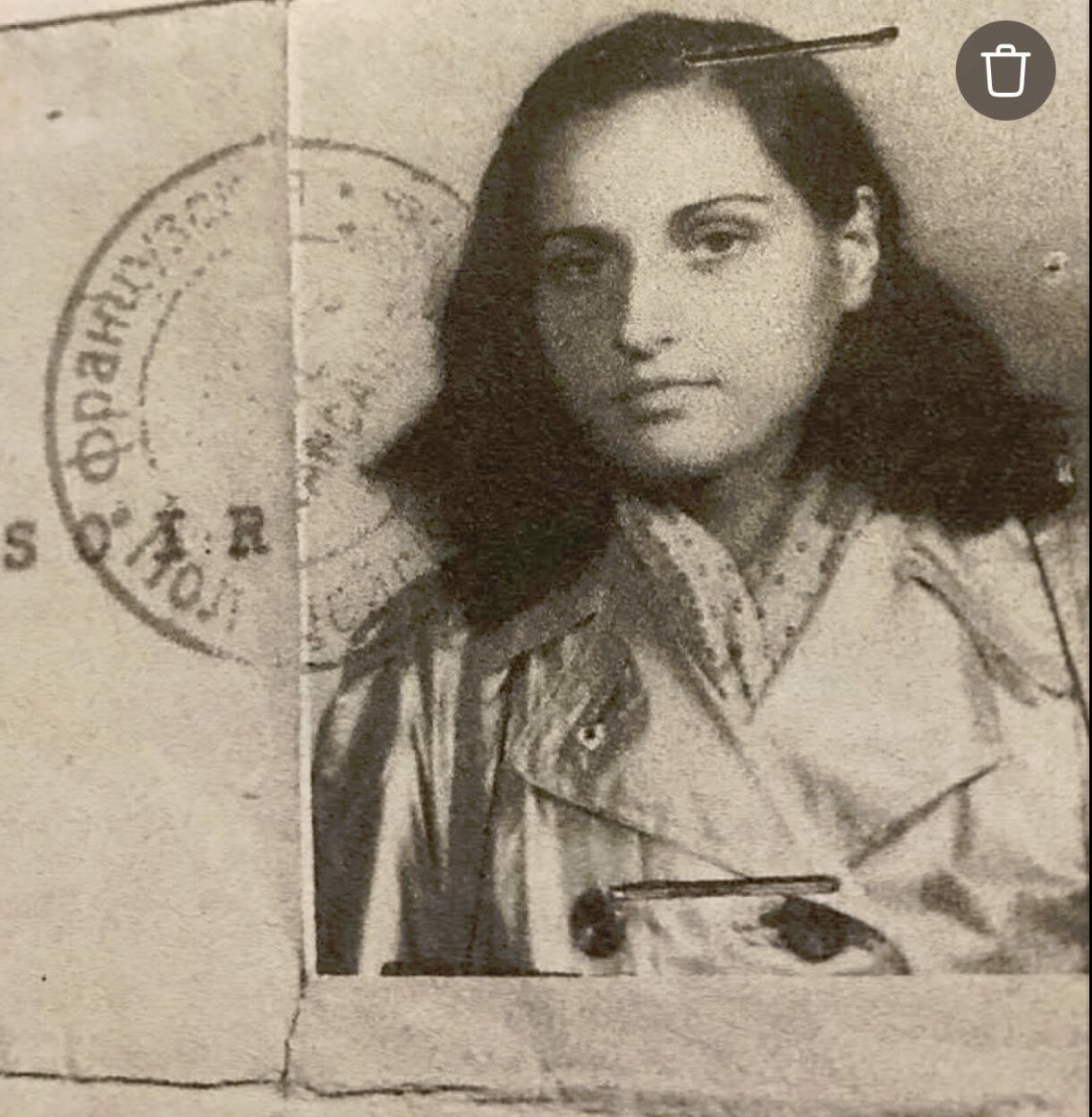 Ines on her camp-release / French-repatriation ID card, 1945 — age twenty, dark wavy shoulder-length hair, looking directly at camera in a Red Cross or service-style jacket. The red-ink stamp on the left names the French repatriation service. The card lists her under her legal birth name, Agnes Cicchinelli, and is the document Aline grew up calling “my mother the Spy.” The actual story underneath — French Resistance, firing squad survived, Wiener Neustadt-Mauthausen, Soviet liberation in April 1945 — is the one Ines told her own daughters very little of in her lifetime.
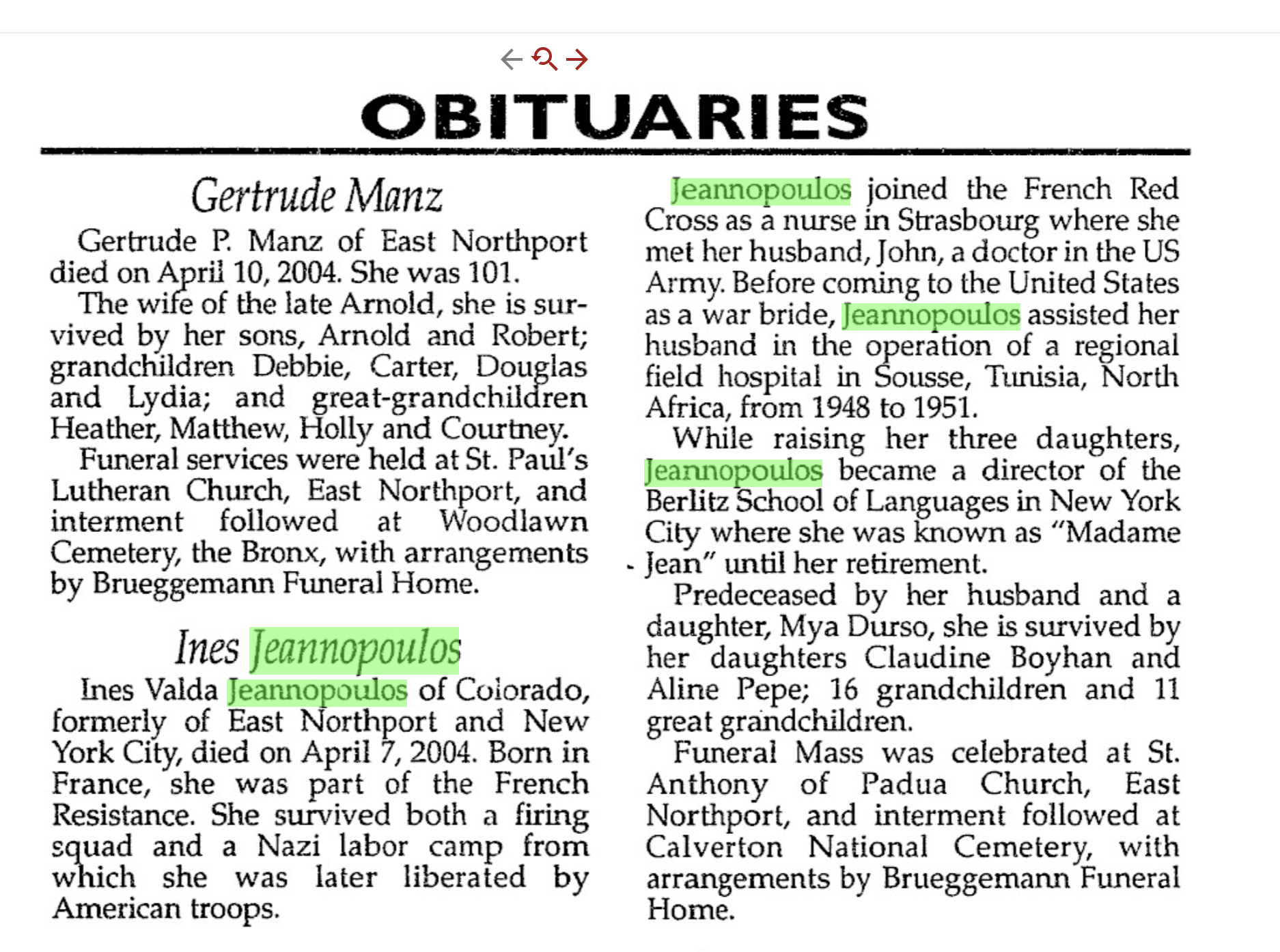
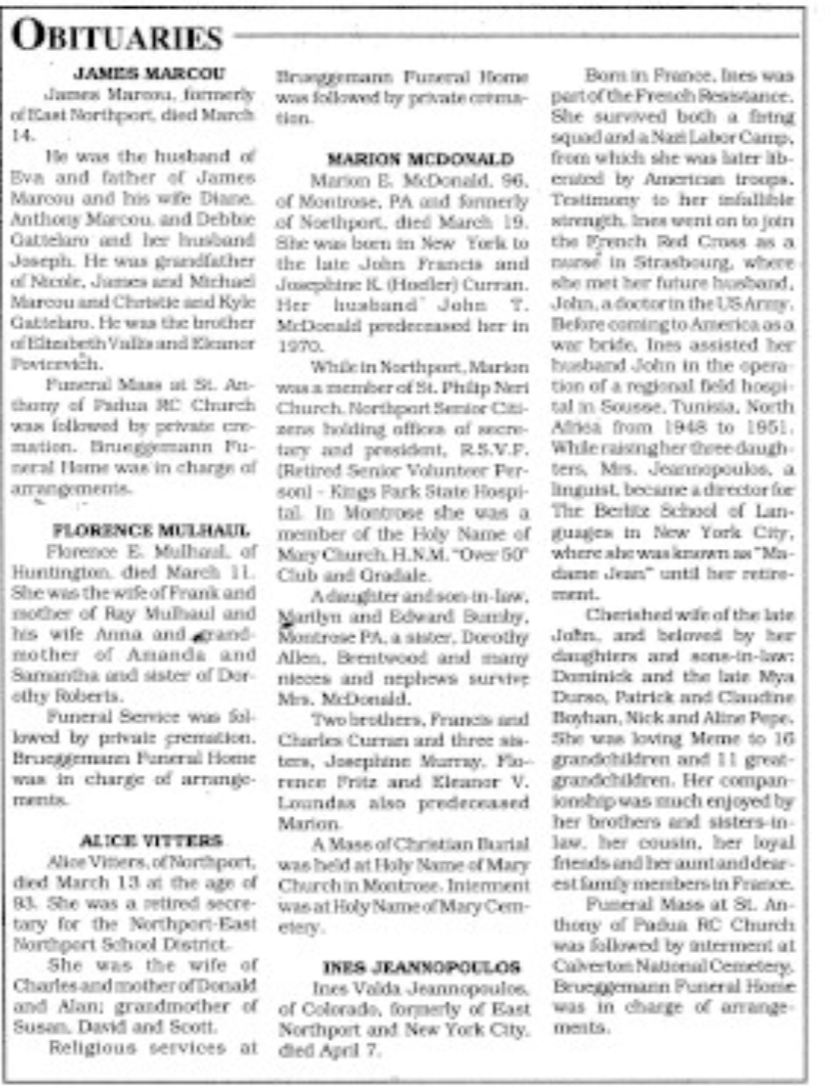
She joined the French Resistance as a teenager during the German occupation. The Germans caught her and stood her in front of a firing squad — and she survived. She was sent instead to the Wiener Neustadt subcamp of Mauthausen, the women’s slave-labor facility tied to the Messerschmitt aircraft works in Austria, where the Reich was building fighters with prisoner labor. The camp was liberated by Soviet forces in April 1945, and she walked out of it at twenty. (Her 2004 obituary mistakenly recorded American liberation; her actual release papers, retained by her daughter Aline, name Wiener Neustadt and confirm the Soviet liberation. The release papers list her under her legal birth name, Agnes Cicchinelli.)
After liberation she made her way west across the chaos of central Europe and joined the French Red Cross as a nurse, posted to Strasbourg — the city on France’s eastern border with Germany, in the postwar Allied zone — where she met John Lazare Jeannopoulos — a doctor in the US Army.
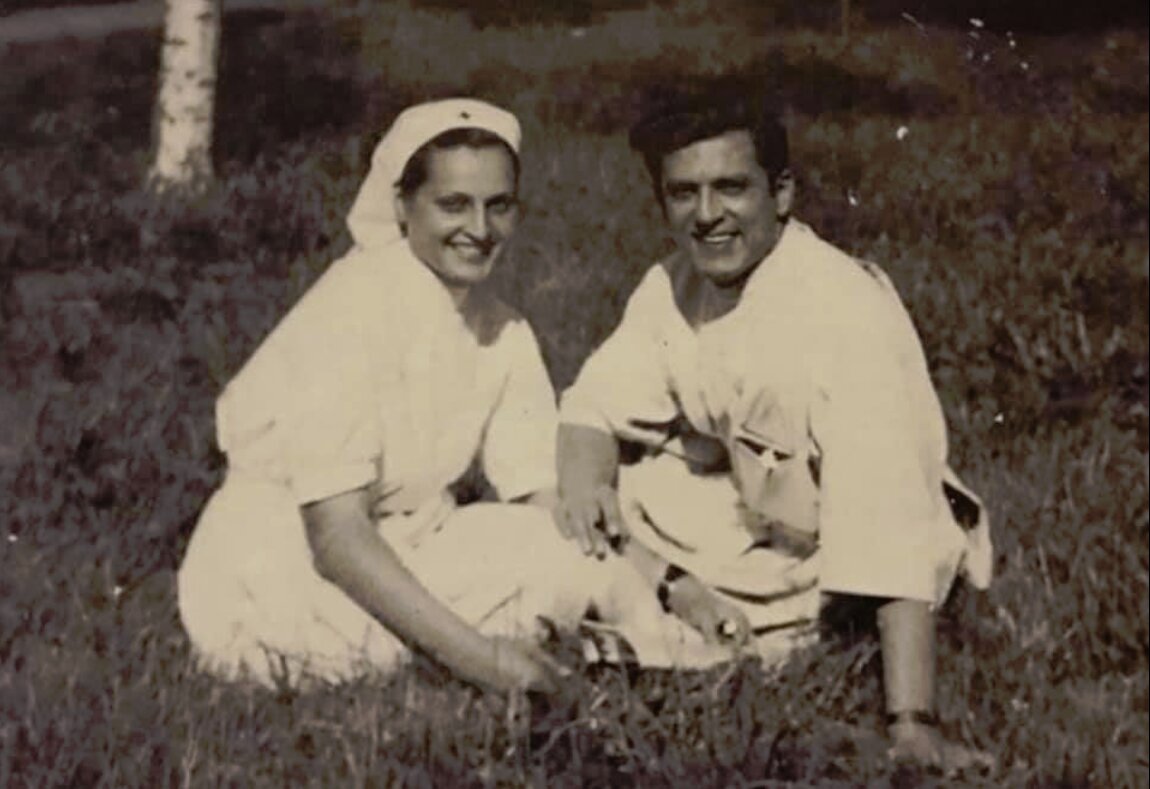 Ines and John together on grass in white clothing, both young and smiling — most likely either Strasbourg in 1945, the year they met, or Sousse, Tunisia in 1948, when they founded the field hospital together. The first couple-portrait of them in the family archive.
Tunisia 1948–51 — the Sousse field hospital
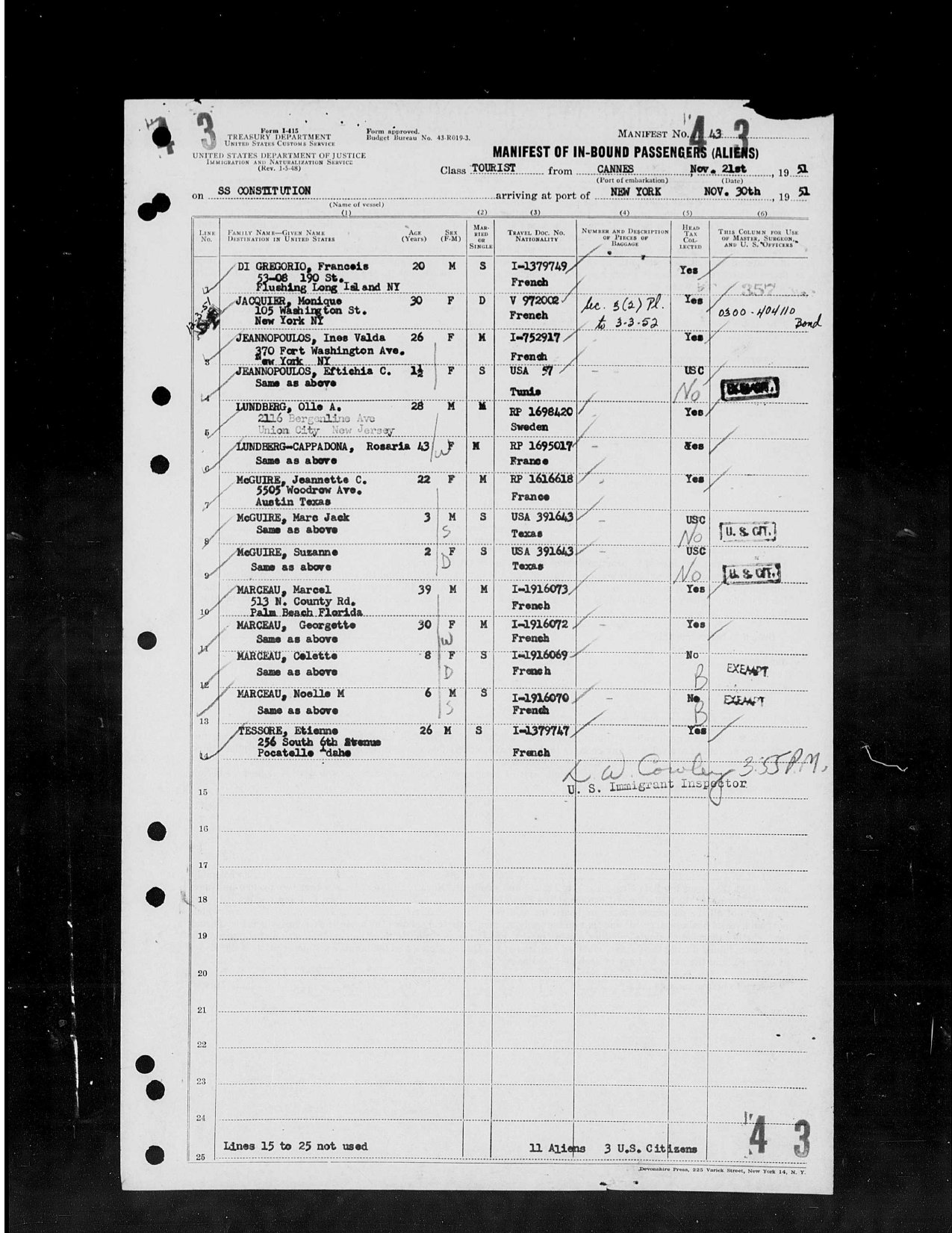
Ines had no pre-existing Tunisia connection of her own. She followed John to Tunisia at the end of WWII, where they married (she was 23) and ran a regional field hospital in Sousse — a port city on Tunisia’s Mediterranean coast — together (1948–51). Their biological daughter Eftichia “Claudine” was born there around 1950, named after John’s mother Eftyhia Karamitrou. Ines and the infant Claudine sailed from Cannes to New York on the SS Constitution on November 30, 1951, Ines then 26, where Claudine appears on the manifest as “Eftichia C. Jeannopoulos, age 1½.”
New York — Madame Jean
Raising her three daughters in NYC, she became a linguist and director at the Berlitz School of Languages, where she was known as “Madame Jean” until her retirement. She also went by “Agnes” — her birth-registration name, which John Lazare’s January 2004 obituary used when listing her as his surviving wife. She later lived in East Northport (Long Island) and Colorado.
She died April 7, 2004, at 79, ten weeks after her husband John. Interment at Calverton National Cemetery, New York.
Family
Three daughters: Eftichia “Claudine” Boyhan (biological, b. ~1950 Tunis, m. Patrick Boyhan), Myriam “Mya” Durso (adopted, m. Dominick Durso, d. 2002), and Aline Pepe (biological, m. Nick Pepe). Sixteen grandchildren and eleven great-grandchildren. Her grandchildren called her Meme.
Her 2004 obituary closes by naming brothers, sisters-in-law, a cousin, and an Aunt as surviving family members from France — leaving open a whole side of her family her American daughters did not grow up knowing. When Aline contacted a Cicchinelli cousin in Maryland at the time of Ines’s death and remarked she didn’t know much about her mother’s life before her sister Mya was born, the cousin replied: “You don’t know your Mother’s Story?”