Sophie wrote at least four books, spanning sixteen years and two languages. The trajectory tracks her own geography: an English-language scientific volume from her New York medical-research career, then three Spanish-language environmental and literary works produced in Santo Domingo and San José after she relocated.
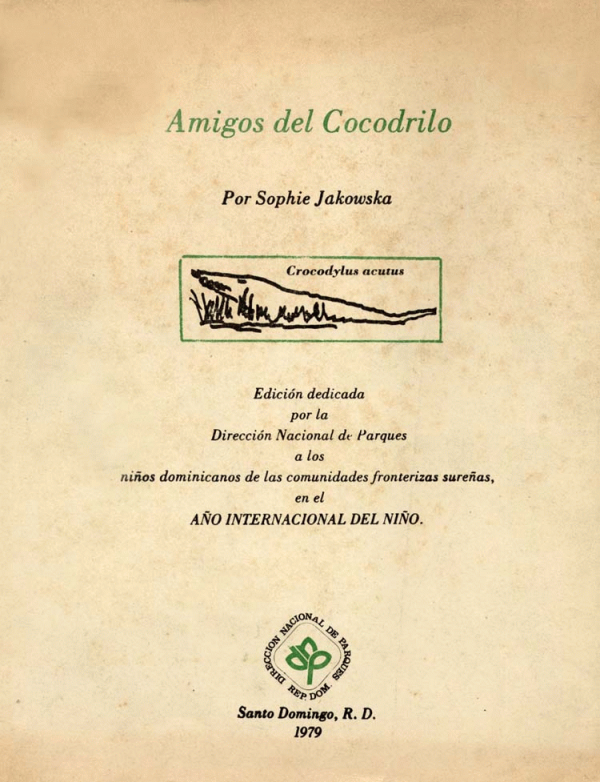
The 1979 Amigos del Cocodrilo — published by the Dirección Nacional de Parques of the Dominican Republic, with a prologue by Merilio G. Morell — directly anticipates the 2007 INPOSDOM commemorative stamp series, which placed Crocodylus acutus (the American crocodile) on her RD$15 stamp. Sophie did not just care about the species the stamps depicted; she wrote the books the Dominican environmental movement organized around.
The four titles
1970 · Cystic Fibrosis and Related Human and Animal Diseases: Symposium Highlights
| Field | Value |
|---|---|
| Publisher | Gordon and Breach, New York |
| Pages | xvi, 240 |
| Language | English |
| Format | Conference proceedings, sponsored by the National Cystic Fibrosis Research Foundation + U.S. Public Health Service, NYC, Feb 29 – Mar 2, 1968 |
| LCCN | 72118382 |
| LCC | RC857 .C9 · Dewey 616.3/7 · OCLC 85669 |
| Internet Archive | cysticfibrosisre0000unse |
| Open Library | OL5314897M |
The book of her American clinical-research years — sitting on top of her 1961-69 work as Asst. to the VP Medical Affairs at the National Cystic Fibrosis Research Foundation.
1978 · Hijos de la Tierra — “Children of the Earth”
| Field | Value |
|---|---|
| Publisher | Ediciones de Taller, Santo Domingo, República Dominicana |
| Pages | 38 |
| Language | Spanish |
| LCCN | 80108202 |
| LCC | PQ7079.2.J3 H5 · Dewey 861 |
| Open Library | OL4130947M |
Her first Dominican publication — and a literary one. The Library of Congress class PQ (Romance literatures) and Dewey 861 (Spanish-language poetry) point to a poetry collection or literary prose, not a scientific work. Sophie’s début in Spanish, in the country she had moved to one year earlier.
1979 · Amigos del Cocodrilo — “Friends of the Crocodile”
| Field | Value |
|---|---|
| Publisher | Dirección Nacional de Parques (Dominican Republic National Parks Directorate), Santo Domingo, R.D. |
| Prologue | Merilio G. Morell |
| Dedication | ”Edición dedicada por la Dirección Nacional de Parques a las niñas dominicanas de las comunidades fronterizas norteñas en el AÑO INTERNACIONAL DEL NIÑO” — Edition dedicated by the National Parks Directorate to the Dominican girls of the northern border communities, in the International Year of the Child (UN, 1979) |
| Pages | 140, illustrated, 27 cm |
| Language | Spanish |
| LCCN | 79122973 |
| LCC | MLCM 80/1227 |
| Open Library | OL4459766M |
| bvearmb.do | Biblioteca Virtual del Ministerio de Ambiente — handle 123456789/2007 |
Sophie’s first state-sponsored Dominican environmental publication. The Dirección Nacional de Parques was the country’s principal national-parks authority; that the agency itself was her publisher means she had, by 1979, been formally welcomed into the Dominican conservation establishment. The dedication to “las niñas dominicanas de las comunidades fronterizas norteñas” — Dominican girls of the northern border communities — anchors the book to a specific audience: girls in the Haiti-bordering north, in the UN’s International Year of the Child. The 1979 book is the source publication behind the 2007 INPOSDOM commemorative stamp series — twenty-eight years before the Dominican government would place a Crocodylus acutus on her RD$15 stamp.
★ En una isla como la nuestra — “On an island like ours”
| Field | Value |
|---|---|
| Author | Sophie Jakowska |
| Prologue | Dr. Idelisa Bonnelly de Calventi (b. 1935) — founder of the Centro de Investigaciones de Biología Marina (CIBIMA) at UASD, recognized as the founder of Dominican marine biology |
| Contributors | Centro de Investigaciones de Biología Marina, República Dominicana · Secretaría de Estado de Agricultura |
| Language | Spanish |
| Year | TBD (the catalog record is incomplete on the date) |
This is the smoking-gun document for the Calventi connection. Idelisa Bonnelly de Calventi — Sophie’s 1959 NY Aquarium co-author on the Ectyonin discovery paper, the woman who would eventually found Dominican marine biology — wrote the prologue. The same Idelisa who, two decades after publishing Ectyonin with Sophie at the NY Aquarium, was the senior Dominican scientific figure writing introductions for Sophie’s Dominican environmental books. The Sophie-Idelisa relationship spans from 1959 New York co-authorship through to Dominican-government-published book forewords — at least three decades.
The contributing institutions on this book — CIBIMA (Idelisa’s institute) and the Dominican Ministry of Agriculture — confirm that Sophie was operating at the apex of the Dominican scientific establishment by the time En una isla como la nuestra appeared.
1986 · La Quiero Libre! — “I Want Her/It Free!”
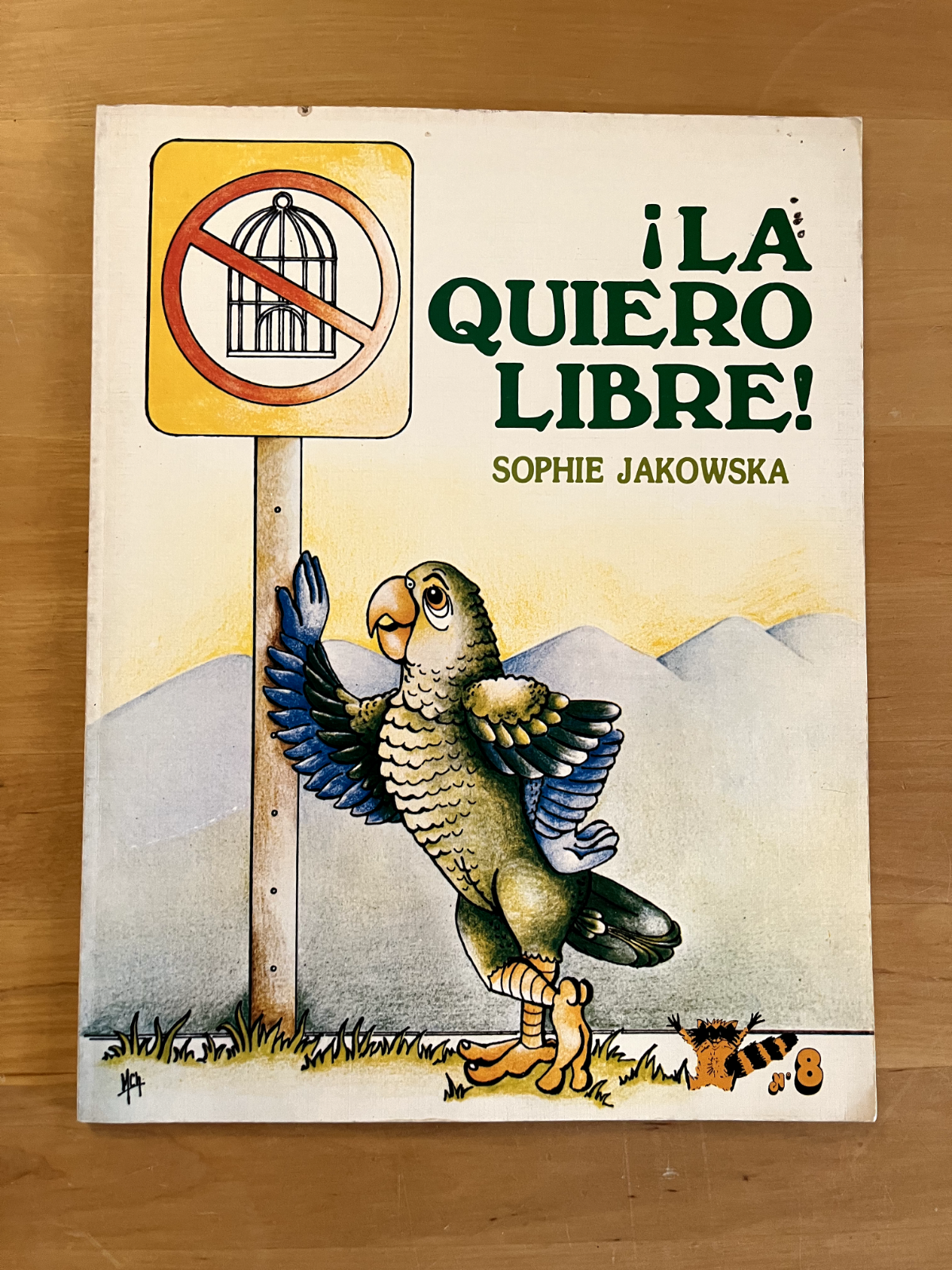
The cover is a child-facing wildlife-conservation tableau: a Hispaniolan parrot standing beside a “no cage” road-sign, the bird raising one wing in protest at the prospect of captivity. The pairing — La Quiero Libre! (“I Want Her Free!”) and the empty cage with a red slash through it — is the visual answer to the whole pet-trade problem the book exists to fight. Same species (Amazona ventralis — the cotorra) that would appear on Sophie’s commemorative RD$10 stamp twenty-one years later.
| Field | Value |
|---|---|
| Publisher | Editorial Universidad Estatal a Distancia (EUNED), Programa de Educación Ambiental, San José, Costa Rica |
| Co-publisher | Fundación de Parques Nacionales (FPN) |
| Funder | Fundación Tinker (Tinker Foundation), New York, USA |
| Pages | 58 |
| Series | Serie Mapachín, no. 8 (EUNED’s children’s environmental/conservation series, mascot the mapachín — Central American raccoon) |
| Language | Spanish |
| LCCN | 92176572 |
| LCC | MLCM 92/08974 (P) |
| Open Library | OL1307926M |
Sophie writing for a Costa Rican children’s conservation series in her mid-60s. The publishing arrangement on the back cover reveals a tri-national environmental-education partnership that was unusual for its time: a New York-based US private foundation (Tinker) funding a Costa Rican distance-education press (EUNED) in collaboration with a regional Parks Foundation (FPN) to produce Spanish-language children’s wildlife books for distribution across Latin America. Sophie was the bridge.
Before the books — the 1947 Fordham PhD
The bibliography’s prehistory begins twenty-three years before the 1970 CF volume, with Sophie’s PhD dissertation at Fordham University, completed June 1947: “A Study of Abnormal Growth Responses in Allium Cepa” (ProQuest #10992979). Faculty advisor was Dr. E.R. Witkus of the Fordham Department of Biology. The dissertation studied plant-tumor biology using Allium cepa (the common onion), infecting plants with Agrobacterium tumefaciens and tracking the resulting growth abnormalities under the microscope — work bridging plant cytology and the fish-cancer research Sophie would pivot to with Ross F. Nigrelli at the NY Aquarium just three years later (cf. their 1951 British Journal of Cancer paper, “The Invasion and Cell Replacement of One Pigmented Neoplastic Growth by a Second, and More Malignant Type in Experimental Fishes” — Nigrelli, Jakowska, and Myron Gordon, NY Aquarium / NY Zoological Society / Mount Saint Vincent).
Sophie’s earlier M.S. at Fordham (1945) and the 1947 PhD together establish that by twenty-five she was a fully credentialed American research biologist, three years off the SS Serpa Pinto and still publishing under her maiden name (Sophie Jakowska) for the rest of her career.
Selected articles spanning the career arc
The “100+ articles” figure that survives in her 2005 obituary covers a half-century of scientific publication. Three pieces, separated by 48 years, sketch the trajectory:
1953 · The pathology of myxosporidiosis in the electric eel, Electrophorus electricus (Linnaeus), caused by Henneguya visceralis and H. electrica spp. nov.
Co-authored with Ross F. Nigrelli (1902–1989), her career-long NY Aquarium collaborator. December 31, 1953. The “spp. nov.” in the title is the technical mark of new-species description: Sophie and Nigrelli were the type authors for two new species of Henneguya parasites in the electric eel — formal scientific authority that lives in the species names themselves. This is the kind of paper that earns a scientist permanent citations in zoological taxonomy — separately from her contributions to medicine, environmental policy, or popular conservation.
1988 · The emerging conservation mystique in the Dominican Republic
A book chapter in Briceño, S. & Pitt, D.C. (eds.), New Ideas in Environmental Education (Routledge; ISBN 9781351054126 in the 2018 reissue), pp. 123–136. Sophie’s most-cited Dominican-environmental academic publication.
The abstract is itself a window onto her late-career thinking:
“The appearance of the new International Union for the Conservation of Nature and Natural Resources (IUCN)-inspired conservation for development clubs named LAURELES within this emerging conservation climate is very timely… LAURELES aim at producing better neighbours and better citizens… In the Dominican Republic there are numerous well-documented examples of ecologically positive initiative and action that originated within the Church or in Church-related groups. Irreversible desertification was presented as an imminent danger in view of the ecological catastrophe in the neighbouring Republic of Haiti.”
Three themes in one paragraph: (1) institutional environmentalism around IUCN’s grassroots clubs; (2) the integration of Catholic-church social networks into Dominican conservation; (3) the Haitian desertification cautionary tale — Haiti, across the border, as the ecological warning Dominicans could not ignore. The 1979 Amigos del Cocodrilo had been dedicated to girls of the “comunidades fronterizas norteñas” — the northern, Haiti-bordering communities. By 1988 Sophie was writing academically about precisely the trans-border ecological dynamic those girls lived inside.
2001 · Conflictos ambientales — luchas sin vencedores
Her last preserved publication, four years before her death. Ciencia y Sociedad 26(1), pp. 103–106 — a Dominican academic journal.
“El bien común ha sido relegado muchas veces para favorecer a intereses individuales a nombre del medio ambiente… El ambiente y sus bienes deben ser considerados como un legado sagrado. No podemos actuar en forma moral sin ser éticos… Muchos de los conflictos ambientales que hemos presenciado directa o indirectamente podían haber sido evitados, o por lo menos podían haber causado menos daño si hubiéramos actuado con criterios morales y éticos.”
(“The common good has often been pushed aside in favor of individual interests in the name of the environment… The environment and its goods should be considered a sacred legacy. We cannot act morally without being ethical… Many of the environmental conflicts we have witnessed, directly or indirectly, could have been avoided, or at least could have caused less damage, if we had acted by moral and ethical criteria.”)
The 2001 piece is the bioethics-pioneer voice the Dominican government would commemorate on its 2007 stamps as Precursora de la Bioética. She was 79 when she wrote it, in chronic pain, still publishing on the moral-philosophy / environmental-ethics frontier that her work had been pushing toward since the 1970s.
What the trajectory tells us
The four books span the exact arc of Sophie’s late-career pivot: an English-language scientific anthology from New York in 1970, then a literary début (Spanish, Santo Domingo) in 1978, then a state-sponsored environmental treatise (Spanish, Santo Domingo) in 1979, then a children’s conservation book (Spanish, San José) in 1986. The language switch is sharp — English up to 1970, Spanish only thereafter — and matches her late-1970s relocation from New York to Santo Domingo with her husband Constantine.
That she was published by the Dirección Nacional de Parques of the Dominican Republic just two years after arriving in the country is itself a quiet measure of how quickly the Dominican environmental movement adopted her. By 2005 her obituary would credit her with “100+ articles” total — these four books are the load-bearing pieces of that output.
Open research questions
- Are there more Sophie Jakowska books than these four? Her 2005 obituary’s “100+ articles” claim hints at additional Dominican / Costa Rican environmental titles not yet in Open Library.
- Who was Merilio G. Morell? The prologue author for Amigos del Cocodrilo (1979) — likely a senior Dominican parks-and-conservation official given the publishing agency.
- Is Hijos de la Tierra poetry or prose? The Dewey/LCC classification says poetry; a copy of the text would settle it.
- Full texts. The Dominican environmental ministry’s
bvearmb.doarchive holds at least Amigos del Cocodrilo and one other (handle 123456789/6028, plausibly Hijos de la Tierra); the Internet Archive borrows the 1970 CF book under identifiercysticfibrosisre0000unse.
Source
Open Library edition records (LoC MARC mirrors) supplied the bibliographic data here. The bvearmb.do handles were pointed out by Alex on 2026-05-22 and confirmed the Dominican-environmental publication track. Archived metadata at OneDrive/Documents/personal/family/ancestry/sophie/sophie_authored_books_bibliography.txt.