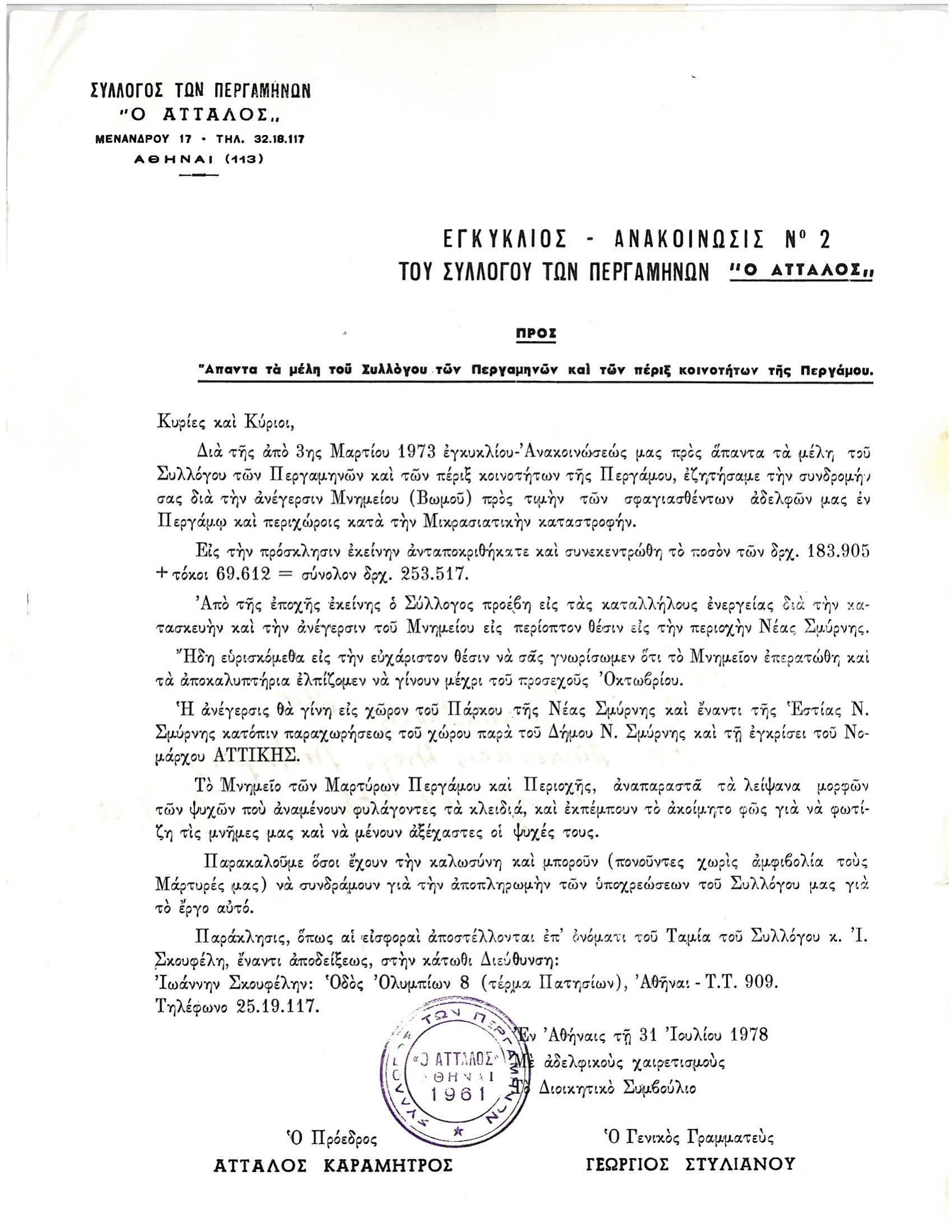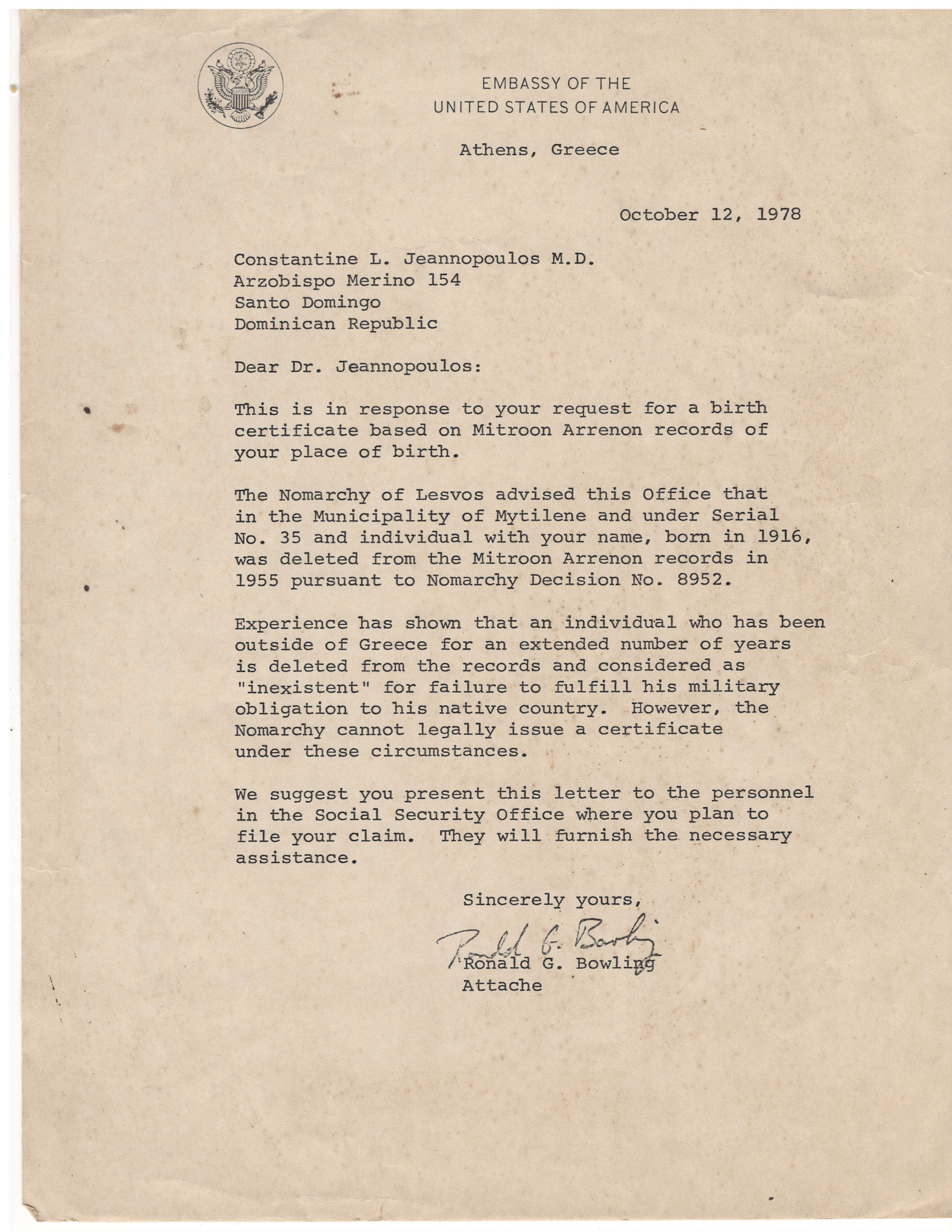
The 1955 administrative event that made the Greek-citizenship case interesting. A letter from the US Embassy Athens — signed by Ronald G. Bowling, Attaché — to Constantine L. Jeannopoulos at his Santo Domingo residence (Arzobispo Merino 154), responding to an inquiry about his Greek civil-registry status. The letter reports, citing the Nomarchy of Lesvos directly:
“The Nomarchy of Lesvos advised this Office that in the Municipality of Mytilene and under Serial No. 35 an individual with your name, born in 1916, was deleted from the Mitroon Arrenon records in 1955 pursuant to Nomarchy Decision No. 8952.
Experience has shown that an individual who has been outside of Greece for an extended number of years is deleted from the records and considered as ‘inexistent’ for failure to fulfill his military obligation to his native country.
The Nomarchy cannot legally issue a certificate under these circumstances.”
What the letter establishes
- Constantine’s entry at Mytilene Μητρώο Αρρένων folio 35 is acknowledged by the Greek Nomarchy as a historical fact — the registry index, the 1916 birth year, the name, all match.
- The entry was deleted in 1955 pursuant to Nomarchy of Lesvos Decision No. 8952 — administrative consequence of his decades-long absence from Greece + non-fulfillment of military service.
- As of 1978 the Nomarchy “cannot legally issue a certificate” of Greek citizenship under the deleted-record status.
- Constantine’s address in 1978: Arzobispo Merino 154, Santo Domingo, Dominican Republic — same address recorded on his 1980 death certificate.
Why the 1955 deletion does not break the chain of descent
For the active Greek-citizenship filing, the 1955 deletion is the central legal-administrative question. Three reasons the deletion does not break Peter’s, Alex’s, or Mia’s jus-sanguinis chain:
-
Greek jus-sanguinis depends on the parent’s citizenship at the time of the child’s birth, not on later administrative status. Peter was born October 1943 — twelve years before the 1955 deletion. At Peter’s birth, Constantine was an actively-registered Greek citizen at Mytilene Μητρώο Αρρένων folio 35.
-
The 1955 deletion was administrative, not a renunciation. The cited reason — failure to fulfill Greek military service — is the standard administrative ground for striking long-absent men from the male register. It does not constitute a voluntary renunciation of Greek citizenship by Constantine, and under Greek citizenship law cannot retroactively un-Greek a citizen for the purpose of descendants’ inherited claims.
-
The Mytilene registry entry can be administratively restored. Greek consular practice provides for the restoration of erroneously-or-administratively-deleted male-register entries — supported by primary-source documentation such as the 1923 Mytilene baptismal certificate and the 1957 Δημαρχείον re-issuance — both of which the family holds.
The 1978 Embassy letter as evidence
The letter is itself documentary evidence in the filing — it confirms in writing, from a US State Department source citing the Greek Nomarchy directly, that:
- Constantine was once registered at Mytilene Μητρώο Αρρένων folio 35 (born 1916);
- The deletion happened in 1955 under a named, numbered Nomarchy decision (#8952);
- The cited reason was administrative (military-service-related), not voluntary renunciation.
These are all facts the consulate filing can cite directly from this primary-source letter, with the 1957 Δημαρχείον re-issuance and 1923 baptismal certificate attached as supporting evidence of the original entry and Constantine’s Greek civil identity.